Showing posts with label Green Design. Show all posts

Wednesday, June 24, 2009

Flexible Solar Powered Rooftop Shingles

Researchers at Pacific Northwest National Laboratory (PNNL) in Richland have developed flexible solar panels that could be installed on roofs like shingles. This technology was originally used to protect flat panel televisions from dampness.They used to cover television screen with transparent, thin films that acted as barriers. These transparent thin film barriers are now becoming the basis for flexible solar panels that would be installed on roofs like shingles. These flexible rooftop solar panels are known as building-integrated photovoltaics, or BIPVs. They could replace today’s boxy solar panels. We all know that current solar panels are made with rigid glass or silicon and mounted on thick metal frames. If we compare present solar panels and flexible solar shingles we will find the later ones less expensive to install than current panels and made to last 25 years.

This technology was developed by PNNL in 1990s. They consider utilizing this technology in fifteen possible ways. One of it was solar power. But when Vitex Systems licensed the technology from Battelle, it refocused its goals. They saw potential and commercial success in developing ultra-barrier films for flat-panel displays, such as televisions. Now Vitex and PNNL, which is operated by Battelle for the Department of Energy, are reorienting the use of ultra-barrier films. The time might be right for them to exploit the current alternative energy scenario. Mark Gross, a PNNL senior scientist, explains “There’s a lot of wasted space on rooftops that could actually be used to generate power. Flexible solar panels could easily become integrated into the architecture of commercial buildings and homes. Solar panels have had limited success because they’ve been difficult and expensive to install.”

The encapsulation process and the ultra-barrier film - called Barix™ Encapsulation and Barix™ Barrier Film, correspondingly - are already established and efficient moisture barriers. Now researchers are trying to find out a technology that could be successfully implemented to solar panels. The research work will be undertaken by Vitex and Battelle. It will be done under a cooperative research and development agreement recently signed by Vitex and Battelle. Battelle is the majority shareholder of Vitex, based in San Jose, California. Currently researchers are engaged in creating low-cost flexible barrier films and they are evaluating substrate materials for solar panels that can survive sunshine, rain and hail for decades. They will also work out the details of manufacturing process for large-scale production.

PNNL’s research will be funded by DOE’s Energy Efficiency and Renewable Energy Technology Commercialization Fund. The estimated cost of the project willbe $350,000 . A commercial match to the funding is required, and Vitex will provide up to $350,900 in labor, equipment and materials. If this project is completed successfully, this progression will decrease solar panel manufacturing costs to less than $1 per watt of power, which would be competitive with the 10 cents per kilowatt-hour that a utility would charge.

“Vitex is proud to continue its long, successful relationship with PNNL,” said Martin Rosenblum, Vitex’s vice president of operations and engineering. “Vitex is excited to further its Barix™ technology’s proven barrier performance for photovoltaics toward mass manufacturing. Together, we look forward to creating a product that will help alleviate America’s dependence on foreign oil and increase America’s access to an abundant renewable energy source - the sun.”

VIRTUAL ENERGY FORUM

VIRTUAL ENERGY FORUM
June 24th and 25th
8:00 AM - 6:00 PM
Online at www.VirtualEnergyForum.com

Come to the Virtual Energy Forum, the world's largest online-only energy conference, to hear over 30 live speakers from a variety of energy backgrounds. The event is focused on how leading companies can adopt better energy management practices to cut costs -- presenting alternative energy technologies, policies, and best practices in a live, interactive environment. Topics include: sustainable energy management, alternative energy, clean technologies, green buildings and operations. The event is completely free and all you need is a computer to attend.

Speakers from our Green Buildings agenda include:
- Bob Dixon from Siemens Builders discussing improving building infrastructures to achieve operational efficiency
- Phil Williams from Webcor Builders will outline the new architectural concept behind the California Academy of Sciences facility located in San Francisco
- Elizabeth Heider from Skanska USA Building, Inc, will talk about sustainability and the Empire State Building
- Constant Van Aerschot from Lafarge will speak about current initiatives to reduce green house gas emissions in the commercial buildings sector
- Grant French, Swinerton Builders, and Stefan Muhle, Orchard Garden Hotel, will discus the hotel's green initiatives

Each speaker will have a live Q&A session where you can ask your most pressing questions about green buildings. Don't miss out on this informative event.

Monday, June 15, 2009

The Greenest Building in Sri Lanka

Article by Smriti Daniel Pix by M.A. Pushpa Kumara


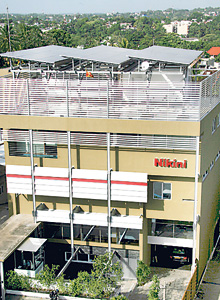
On the roof of the Nikini building, four stories up, it’s a windy day. Employing some caution, we step delicately along a narrow passage between an array of solar panels. Sharing our tenuous perch is Upendra Weerasuriya, proud owner of Sri Lanka’s first zero-energy building. First opened in 2008, the structure’s design ensures enough energy is generated to meet its daily requirements, even allowing for excess energy to be donated to the public grid.

Currently, the building houses the offices of Mr. Weerasuriya’s industrial automation business along with his personal residence. As a result, Mr.Weerasuriya likes to point out that his carbon footprint has been considerably lowered not just because his building generates its own clean energy, but also because he no longer burns up fuel commuting to work.
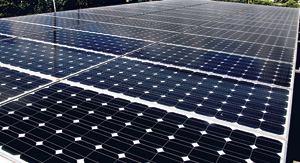
The array of solar panels on the rooftop.
The courtyard right in front of the building


Dr. Upendra Rajapaksha is the architect responsible for the building’s revolutionary design. Mr. Weerasuriya says his brief to Archt. Rajapaksha was simply: “I don’t even want a generator. The building should be hundred percent CO2 free” – a challenge that the architect was more than up to. Having spent many years engaged in research (he holds a PhD in low energy architecture, and teaches the subject at the Moratuwa University) Archt.

Rajapaksha has implemented several key principles of his study in the design of the Nikini building. Distinguishing between a green building and a zero-energy building he says that a zero-energy building is about more than just minimising energy usage. Instead these buildings produce as much energy as they consume.

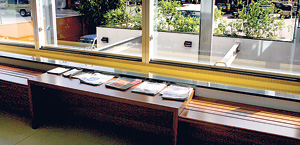
There are no light switches in Mr. Weerasuriya’s office. Instead, a discreet touch pad, which requires a password, switches on the lights. Even this is only possible if the sensors installed around the office report that the natural light is insufficient. Archt. Rajapaksha’s design has ensured that this rarely happens except at night - large windows allow for a flood of sunlight.


But the inhabitants of the office would rather they have the light without the heat – and so cleverly designed louvres operate like sunshades, responding and adjusting to the direction of the sun, protecting the building. Another small touch, a sunken courtyard right in front of the building, creates a shaded area that does not reflect heat back on to the structure.

The plants that thrive in this courtyard are all watered with the rain water collected in four giant tanks, which hold up to 20,000 litres. These are placed on the roof of the building, underneath the solar panels. Their positioning eliminates the need for pumps, as water simply flows downward, supplying everything from the showers and the flushes to the taps in the canteen. The first 250 gallons of rainwater is traditionally discarded as it contains all the dust off the solar panels.

Lightning is the great nemesis of solar panels. Mr. Weerasuriya shows us his solution. It is no ordinary lightning rod, but a special lightning arrestor known as an early streamer whose sensors identify if the cloud has negative ions for instance and then spray positive ions to neutralise it, thereby preventing a lightning strike.

All these measures are essential to protecting what amounts to an expensive investment. The 140 solar panels that are spread out across this roof cost Rs.200,000 each, but with a 20 year warranty and the power to generate approximately 125 kilowatt hours per day, they’re what their owner sees as a good buy.

Archt. Rajapaksha adds that though such designs may cost approximately 15% more to build than a conventional structure, the pay off comes in the form of a cleaner environmental bill in an era of global warming. For Mr.Weerasuriya, it helps that he is always informed on how his state of the art system is performing. Run on a controlled network developed by Nikini, it will send Mr.Weerasuriya an SMS should any system component experience problems.

Mr. Weerasuriya’s fall back plan is not a generator but a set of batteries. If the main grid experiences a power cut, then this building automatically isolates itself, preventing any electricity from flowing into the grid. The batteries are kept fully charged on solar energy and it’s only if these run out that the building returns to the grid. Even then, “if we deduct the energy we gave the grid during the day, our energy usage would be zero or minus because we are giving more to the Electricity Board than what we take,” says Mr.Weerasuriya.

Archt.Rajapaksha points out that almost all the energy is diverted to the grid during the weekend, when the office is closed. The entire exchange is carried out with the aid of an import-export metre – another innovation by the company.

When compared to a conventional building, Archt. Rajapaksha says he has scaled back on the structure’s energy consumption by 40% through design alone, and that he turns to things like solar panels to generate the remaining 60%. Thoughtful design and careful selection of energy efficient appliances like air conditioners further reduce the structure’s energy requirements. Multiple invertors allow three phases, and the employment of standard alternating current makes it possible to run the full range of daily appliances with ease.

A little display in the reception area has only good news to share. The system has generated over 107 kilowatt hours today, and it is only a little past noon. Its tally since October has been over 28,000 kilowatt hours. For most of us, though these numbers are impressive, they are still abstract figures. There’s a third though, that does embed Nikini’s achievement firmly in the real world. Since October 2008, their zero-energy building has prevented over 19,644 kilograms of CO2 emissions by its reliance on solar power – to put it into perspective, that’s enough to drive over 98,000km.

Tuesday, June 9, 2009

Architects to design tower block – for Animals!

By Marguerite Lazell

Leeds-based Garnett Netherwood Architects has won a quirky competition to design a tower block for animals.

The 12m-high towers - proposed for the Holbeck Urban Village project in the city centre - are designed using recycled materials from demolished buildings to provide a habitat for various forms of wildlife.

The competition encouraged architects to consider how man and beast could “live in harmony” and the winning practice hopes the towers could provide a home for species which could range from bees and insects to swifts, bats, otters, foxes and rodents.

Associate Neil Oxlee told BD that local knowledge had been key to the practice's success in the competition, which attracted 31 entries from around the world.

He said: "Because we're Leeds-based, we knew the area quite well - we thought we had a chance."

Oxlee added that the specification of the towers would be dictated by the materials discarded by the demolition of buildings in the area.

"In Holbeck there's lots of old buildings being knocked down, and site waste is a massive issue,” he said. “You could use steel frames, roof materials… it would be an organic process where you see what you've got."

Competition judge and chair of RIBA Yorkshire Geoff Ward said: "The design had the right balance of ambition alongside a sensitive understanding of the local environment. Also, its high visibility gives it potential to be a focal point for engaging and attracting the community."

The winning entry will be on display at Round Foundry Media Centre throughout June. The other 30 designs will be framed and on display at venues around the Holbeck Urban Village.

Friday, May 29, 2009

Breaking Wind in Sri Lanka


Wind power is the fastest growing industry in the alternative energy sector. Wind turbines generate clean and green power for us but they have certain precondition.One of it is the power unit has to be set up in strong wind area. But Green Energy Technologies has developed a brand new wind power generator known as the WindCube. It is smaller compared to the normal wind generator. WindCube is specially designed to set up on the roof of a building in urban and rural areas. WindCube carries a 22 x 22 x 12 feet framework and its single unit can produce a maximum of 60kW of power. Mark L. Cironi, who is the president and founder of Green Energy Technologies, explains, “Building owners anywhere can consider being a part of the renewable energy picture. With WindCube, it’s not necessary to have the wind of Kansas or Nebraska to become a generator of wind power. In states with excellent renewable energy incentives, moderate wind and high electric rates, the payback can be as little as three years.”

CEB took the initiative to carry out a detailed wind-monitoring programme in the south-eastern part of the country in 1988. The area covered under this project was about 1500 km2. Initial studies of wind resource assessment in the Southern coastal belt of Sri Lanka was conducted during the period from 1988 to 1992 with financial and technical assistance from the Government of the Netherlands. The study revealed that the total potential of wind power generation in the South-eastern part of the country to be 200 MW. This excluded the land area for wild life reserves and agriculture.

Following the resource assessment phase, CEB started to plan its first grid-connected wind power plant of capacity 3 MW to be sited in Hambantota on the south-eastern coast. It was planned as a pilot plant for CEB to get hands-on experience and also to study the implications of integrating wind power into the grid system. Feasibility study and design of the plant were carried out using the database developed by the earlier wind resources study.

The total capacity of the pilot wind farm is 3 MW consisting of 5 wind turbines of 600 kW each. The expected annual energy generation is around 4.5 GWh. The project was financed by the World Bank and Global Environmental Facility (GEF) and was commissioned in March 1999. The total project cost was around Rs. 280 million, of which 66% was foreign funds and 34% local. The foreign cost of the project was financed by the World Bank and the Global Environmental Fund, whereas the total local cost was borne by the CEB. Approximately 25% the foreign cost was provided by GEF as grant.

The semi-annual progress report for year 2000 for this project is available at SAR. This report consists of two sections (A) Pre construction and construction experience and (B) Update on the energy production and operational problems associated with the project. The objective of the report is to share the experiences of the pilot project with the general public and to assist and guide future wind power developers in Sri Lanka.

Although Practical action sites some very valuable information regarding wind energy here, the doing part is more or less non existent. when I contacted them last year with regard to a project that I was working on, an irritated person at the other end said that they haven't done any wind turbine projects in Sri Lanka.

How ever I do recall in 2005 reading a leaflet with regard to a company which manufactures domestic wind turbines in Sri Lanka. I was unable to locate them.

With the present state of develepmont in Hambantota I would like to see if setting up of some more windturbines to the already existing bunch would be economically viable.

Sunday, May 24, 2009

Zero Emissions Motorcycle

When we think about green energy vehicles we often think about modest designs and low speeds. But 6 final-year engineering students of Kingston University have designed a bike that dispels all myths about green vehicles.This bike has the ability to reach speeds of 102mph, race around a 38 mile mountainous course and is powered by batteries that can be charged from a standard household socket! They will take this bike to the world’s first zero-emissions Grand Prix this summer. The Kingston team will be competing with 24 eco-bikes from America, India, Italy, Germany and Austria at the 2009 Isle of Man TTXGP. Mr. Paul Brandon who is the Course Director for motorsport and motorcycle engineering shared his views, “Being green doesn’t have to mean slow. There are too many skeptics when it comes to electric vehicles but we all need to reduce our CO2 output and this initiative is taking a huge leap in that direction. The ideas we and others put to the test on the racing circuit are the ones most likely to become commonplace on the road.”

Students were working on this project since October last year. This project is also a part of their final assessment. The bike is run from a custom-built, 72-volt battery. According to Mr. Brandon, “The energy density of batteries is far less than that of petrol or diesel so how we manage the energy we carry is critical to our success in the race. The bike we have designed has a whole vehicle efficiency of 90 per cent, so we are only wasting 10 per cent of what we carry. By comparison a petrol-based vehicle wastes 70 per cent of the energy it carries.”

Alex Jones-Dellaportas, one of the team members claimed they have designed the bike through different stages. They focused on making the bike faster and lighter. Most of the materials they used for the bike were recycled. Another student elaborated further that appearance wise the bike looks like any other bike but there is a huge difference. This motorbike has no internal combustion engine, no exhaust system and no fuel tank. It goes without saying that the overall CO2 usage, including the carbon dioxide generated to charge the batteries, will be around 50 per cent less carbon dioxide than a petrol or diesel-power bike. Gonzalo Carrasco, another student of the team says, “People need to realize that this technology is the future. By entering green races and building green designs we are hoping policy-makers will see the potential for this technology and start investing in it.”

Azhar Hussain who is the founder of TTXGP motorcycle race, is quite enthusiastic about the team’s motorbike. He too wants to watch the motorbike in action when it would be racing against formidable competition from around the globe on one of the most challenging road race courses in the world. Azhar Hussain thinks that Kingston University team has done a great job and if everything goes right then the exposure for Kingston will be priceless


Saturday, May 9, 2009

Vesak: Times have changed.

image from kaputa.com

I’ve been making Vesak lanterns since I could remember. The colorful tissue paper and the pappa (glue made from mixing flour and hot water) are the first indicators of Vesak. Kids flocking into shops playing havoc with the mudalali in selecting tissues are a very common sight within the month of May.

Vesak is a time of bright colorful lights breaking the dullness of the Sri Lankan nocturnal skies. It’s a time where the behavioral patterns of people change. People actually tend to give stuff for free! and they also tend to acquire a temporary syndrome of compassion, and comradeship. Its just plain weird.

I have been feeling less and less “vesakier” as the years pass by. This year the excitement has totally gone..almost. Nonetheless I did make a vesak lantern! I went to a small shop on way home to purchase some tissue paper and I noticed an odd looking lantern….Cripes! It’s made of plastic. I’ve seen metal ones and timber ones..but plastic? The good thing about this one was that it could be de-assembles and re-assembled, it looked like something made out of my meccano-set which I played around with when I was a kid.

What’s the whole deal about Vesak lanterns anyway? I always thought they symbolized impermanence of life. Vesak lanterns are supposed to burn away or get weathered with rain, ultimately it should break.

One of the most innovative Vesak lanterns I saw this year was not in actuality but in the cyber goo of facebook. The whole lantern is made out of discarded CD's. I really don’t know to whom this belongs to, it just popped out from my FB account.


I guess Vesak is moving up with the times. Any way its green!...is it?

Wednesday, May 6, 2009

First Public Charging Station for Electric Cars


During a low-key ceremony just over a week ago, the first public high-voltage charging station for electric vehicles was inaugurated at the Gateway Center in East Woodland California. Representatives from Tesla Motors were on hand to help demonstrate with six Tesla Roadsters. The power station is capable of charging an electric car in about one hour and is meant to set an example for future stations being planned in other states.

The station is a result of collaboration between developers and the city, and is located east of Interstate-5 off County Road 102 at the Gateway Center. It contains one Tesla, two AVcons, one small paddle inductive charger, plus two neighborhood electric vehicle standard outlets. Plug-in America estimates that some 200-300 EVs of various types are located within 100 miles of the site, which will accommodate all new EVs and PHEVs.

Monday, April 27, 2009

Moxon Architects Hedgehog building


Last week, Moxon Architects announced that permission was granted to construct the Hedgehog building, also known as 163 PRS / Olivers Place. The 40,000 square foot office building is located in Prestons, England.
the primary architectural expression of the building is through an array of anodised aluminium fins, cantilevered from vertical support brackets on all four façades of the building. The aluminium fins, are all oriented in the same direction.
Seen at designboom.. More images after the break.


Saturday, April 4, 2009

More Efficient Palladium Fuel Cell Catalysts


We use many small devices in our everyday life. And each small device needs power. Now devices are becoming smaller with each passing day hence scientists are finding out ways to power them.

Scientists are putting their effort on a material known as palladium. This may turn out to be a hopeful substance in near future to power fuel cells. Another advantage that palladium has over other metals is, it is cheaper and more abundant. Vismadeb Mazumder who is a graduate student and assisting chemistry professor Shouheng Sun in writing the paper, explains the benefits, “This approach is very novel. It works. It’s two times as active, meaning you need half the energy to catalyze. And it’s four times as stable.”

Palladium nanoparticles are used by others too, to power fuel cells. Researchers are facing some hurdles in creating palladium nanoparticles with enough active surface area to make catalysis efficient in fuel cells. They have another problem of preventing particles from clumping together during the chemical processes that convert a fuel source into electricity. Now two Brown University chemists are trying to overcome those hurdles. They are claiming to develop palladium nanoparticles with 40% larger surface area. They also tackled the problem of the clustering of palladium nanoparticles. This catalyst’s shape remains intact four times longer that what is presently offered by others.

How did they achieve this feat? How they retained the shape of the palladium nanoparticles and how they increased the surface area? Mazumder and Sun produced palladium nanoparticles 4.5 nanometers in size. They fastened the nanoparticles to a carbon platform at the anode end of a direct formic acid fuel cell. What is novel here? They did something original. They utilized weak binding amino ligands to keep the palladium nanoparticles separate and at the same size as they’re attached to the carbon platform. This approach is the key to increasing the surface area. Because when the particles remained separate and uniform in size, they increased the available surface area on the platform and raised the efficiency of the fuel cell reaction.

That’s not all. The specialty of the legands is they can be “washed” from the carbon platform without endangering the integrity of the separated palladium nanoparticles. This step proved crucial for the duo researchers and better than previous attempts by other scientists. If you tried to remove binding ingredients it caused the particles to lose their rigid sizes and clump together, which gums up the reaction. Mazumder stated, “We managed to ebb the decay of our catalyst by our approach. We made high-quality palladium nanoparticles, put them efficiently on a support, then removed them from the stabilizers efficiently without distorting catalyst quality.”

Monday, March 30, 2009

New sensors in street lamps 'to save 9,000 hours of energy a night'

Street-lamp sensors which react to changing light conditions are being upgraded across Southwark to reduce energy usage.

The sensors measure outdoor brightness and then switch lights on or off as required.

Sensors have been in use for several years, but Southwark's engineers have carried out several studies allowing them to reduce the time each light is on by 30 minutes per day.

Council bosses say this will reduce energy consumption by thousands of hours a night, and called for the scheme to be rolled out across London.

Eddie Henry, Southwark council's director of street lighting, said: "We looked at schemes like dimming, or turning off lights altogether. But in London, for safety reasons these are just not viable options, so we decided to experiment with changing the light levels at which we actually turn the lights on."

The unit of measurement for light is the "lux". Daylight is defined as 100 lux and street lamps were programmed to come on when that dimmed to 70. However, work by Southwark Council's street lighting team has shown that lights do not actually have to be turned on until brightness drops to 55 lux.

Mr Henry said: "We found it makes absolutely no difference. People will see no change at all, yet we will save 9,000 hours per night of electricity if all our lights are upgraded."

Southwark has already installed the new system on 2,000 street lamps, and hopes to double that number by the end of the year.

Councillor Jeff Hook, Southwark council executive member for environment, said: "Southwark is committed to achieving a number of carbon reduction targets over the next few years.

"We are calling on residents to switch off and save energy. But we have to walk the walk too. The council provides more than 200 services for its residents and is always looking for ways to reduce emissions across the organisation."

Nanotech Batteries - A New Energy Future

People want to use clean and green energy and live easy on earth’s resources. Many are changing to hybrid cars and using solar panels side by side with conventional sources of energy. But they hold a grudge. How to store large amount of energy in batteries?

Hybrid cars fit batteries for power storage. But this power is not enough to last long distances and takes many undesirable hours to recharge. The storage battery is not very helpful during acceleration. Solar and wind also don’t provide us with power at constant rate. They give us energy intermittently. Their storage devices also take lots of space and money as well and yet they don’t seem promising for surge demand. Gary Rubloff, who is the director of the University of Maryland’s NanoCenter is also voicing a common consumer’s concern, “Renewable energy sources like solar and wind provide time-varying, somewhat unpredictable energy supply, which must be captured and stored as electrical energy until demanded. Conventional devices to store and deliver electrical energy — batteries and capacitors — cannot achieve the needed combination of high energy density, high power, and fast recharge that are essential for our energy future.”

Scientists at the Maryland NanoCenter at the University of Maryland have produced new systems for storing electrical energy derived from alternative sources that are, in some cases, 10 times more efficient than what is commercially available.

Electrical energy storage devices can be categorized into three groups. Each group has its advantages and disadvantages. Batteries, mainly consisting of lithium ion, accumulate large amounts of energy but cannot afford high power or fast recharge. The second type is electrochemical capacitors (ECCs). Their advantage is they can offer higher power at the price of relatively lower energy density. The third storage device is electrostatic capacitors (ESCs). They store charge on the surfaces of two conductors. This way they are capable of high power and fast recharge, but at the price of lower energy density.

Scientists are using new processes to enhance the storage capacity of the devices. They are banking upon millions of identical nanostructures having peculiar shapes that will facilitate energy transport with the help of electrons. Electrons will move to and fro and store energy at a very large surface area. We all are familiar with the fact that materials behave according to physical laws of nature. The Maryland researchers are using this fact to their advantage. They are utilizing unusual combinations of these behaviors to produce millions and in the end billions of tiny, virtually indistinguishable nanostructures. These are supposed to receive, store, and deliver electrical energy.

Scientists are concentrating on self-assembly, self-limiting reaction, and self-alignment behaviors of nanostructures. Rubloff clarifies further, “The goal for electrical energy storage systems is to simultaneously achieve high power and high energy density to enable the devices to hold large amounts of energy, to deliver that energy at high power, and to recharge rapidly (the complement to high power).”

The Maryland research team is going for electrostatic nanocapacitors. They significantly increase energy storage density of such devices - by a factor of 10 over that of commercially available devices. This advance puts electrostatic devices to a performance level competitive with electrochemical capacitors.

The research team is right from the beginning building up the technology for commercial purposes. Their outward appearance would be like thin solar panels produced at economical costs. Multiple storage devices can be staked one over the other inside a car battery system. For the solar and wind energy storage they dream about the fully integrated with storage devices in manufacturing.