Showing posts with label Urban. Show all posts

Monday, October 18, 2010

The forgotten CESMA

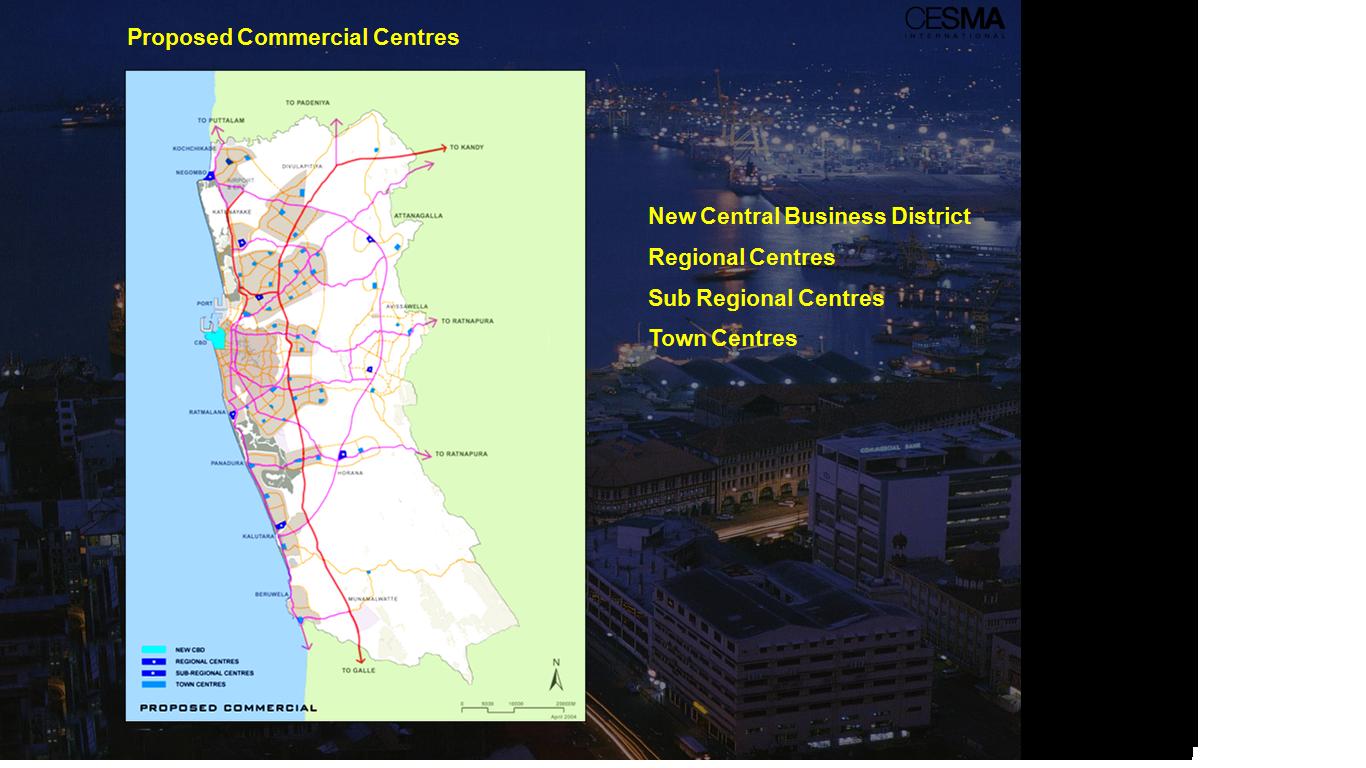
I was reading this article on the leader about a 2020 urban plan for Colombo. What ever happened to the 2030 Cesma proposal made somewhere around 2003-2004? I couldn't even find any references on Google! Why does Sri Lanka need to spend so much money on urban plans when we don't really do anything about them? The so called 2020 plan is nothing but a bunch of words.


Some slides of the forgotten and unrealistic yet very very pretty Cesma plan.


Monday, July 19, 2010

Sustaining Colombo through sustaining colonial remnants


Professor Munasinghe in a interesting article to the Sunday Times talks about Colombo and how it should evolve giving consideration to its colonial history. He goes on to say that "Colombo, we note, is one of the most fitting examples to test the hypothesis of development through conservation- using cultural and heritage values to design a development framework"

Leaving aside the romantic notions of the colonial grandeur, should we conserve the so called colonial heritage which our colonial masters bestowed upon us? What should we really conserve?

He further mentions "Our proposal is not to import life patterns that have little to do with living society, its day-to-day activities or its particular origin and evolution, but to regenerate the old city fabric to make conservation of Colombo an economic feasibility. In addition to new uses and users, it is necessary to take measures to control rents, land ownership, and land utilization to control undue increase of property values or gentrification but without curtailing the growth of the city. Infusion of so-called cultural activities to make the historic fabric function alone may not be sustainable in Colombo but striking a balance between conservation of historic fabric and adding new may make the city function as one unit."

Are we conserving Colombo for the sake of Sri Lankan's or the foreigners that we expect would to pour down in the coming years?

Friday, May 28, 2010

The American suburban nightmare and the success of Walmart


Unlike the traditional neighborhood model, which evolved organically as a response to human needs, suburban sprawl is an idealized artificial system. Sub urban sprawl is something that we, as Sri Lankans should not be too worried about. In the US, there are a whole bunch of reasons for the rise of the sub urban sprawl. And some sociologists even connect it with racial politics. Shopping centers are considered as one of the five components of sub urban sprawl. In the USA, Wallmart is considered the largest and most powerfull supermarket chain. It has even been called "the most powerful company ever to exist." In simpler terms If Walmart were a country, it would be the world's 26th largest economy.
Walmart runs on a very basic principle, provide people with cheaper goods. How they achieve this is a totally different story. They generate profits through volume rather than through high markup, and they strive to save their operational costs as much as possible. There’s a whole lot to be learned through the walmart operation, on a individual level, a professional level or even at a national level.

More information can be found here.

Sunday, March 14, 2010

The Urban Planning Game

Try out this site. Its a primative 3d game, where the objective is to plan a city. Dont expect any fancy 3d graphics, its just basic. Its really silly, but its also kind of neat.

Sunday, November 15, 2009

New Urbanism

Urban Spaces in Shapes and Sizes

Found this site on urban spaces while browsing. Check out the video below for more details.

Friday, June 26, 2009

The Street Child: An Urban Product


This, an advertisement placed at colpetty (In front of Liberty Plaza) aiming at educating people on the importance of keeping children off the street, is a good example of urbanity seeking ways to answer some of the problems it itself has created.

Below find a strikingly similar campaign by "Aseema" a nother organisation which provides education for Street and Unprivileged Children in Mumbai.


This image was stolen from here

Tuesday, June 23, 2009

Kandy City Center: Friend or Foe?

Image stolen from here

Kandy City Centre" Commercial and Shopping Complex at Dalada Veediya, Kandy is the most modern commercial complex in Sri Lanka. The Complex is designed with ultra modern features yet preserving the iconic Kandyan architecture. With respect to this unique entrepreneurial marvel, The Board of Investment has granted the prestigious "Flagship Status" to this Project. Several leading banks, a fully equipped supermarket, a variety of restaurants, an entertainment zone, a well designed state of the art food court will also feature in the Complex. - Source


Image stolen from here

The ten-storied complex designed by K.M.C. Architects of Singapore has two floors underground and is the first building in Sri Lanka constructed in this manner. -source
The local consultants for the project was Ashley De Vos Associates.

Image stolen from here

I recently visited the KCC and even though had earlier read very critical comments on the design (and was partially in agreement) However after my visit I was slightly moved by this solution. Refer the official web site here for more details.

Image stolen from here

download a document with critical comments on the design here (right click and save as)

Image stolen from here

Saturday, May 9, 2009

The Sri Lankan Urbanscape and the Billboard


Reading cernos blog entry on road side advertisements made me want to write one of my own.


If I recall correctly it was at the Architect 2008 annual sessions that this topic got heatedly debated. Many distinguished Architects raised their voices on the use of bill boards/road side hoarding and other distracting advertisement boards proliferating the roadsides not only in and around Colombo but also in outstation areas where we are entertained by the occasional soap drama billboard.


Got this from cerno's blog


The majority were arguing how these hording disrupt the urban scape of Colombo, and I was thinking to my self what urbanscape????????????...I mean to preserve something, that THING should exist. apart from the cluttered haphazard petti kada (Box Shops), and the aluminum clad glass wraped monoliths that rise amidst raging sun and the rising dust, I havent seen much of a urbanscape in colombo. The street vendors of pettah who shout at you when your in a hurry and accidently knocks off one of their things from the make shift shelves on the concrete paving, or the king coconut carts invisible to those inside their air conditioned vehicles are the only signs of life I've vitnessed here. And since I’ve lived/schooled/sleeped/rathiyadued (the past tense of rasthiyadu?) in Colombo for the better part of my life I believe that I am qualified as the next guy to express my views in this regard.

Call me crazy but I find these billboards rather entertaining. I don’t mind glancing upon a billboard advertising some two bit overrated soap on sirasa, driving along galle road or to catch a glimpse of the latest dialog GSM hoarding or even the half way driven car through a billboard! I believe that dynamism is what makes a true urbanscape. And these billboards are some what keeping the streets alive, giving a break to people passing who are tormented by dust, heat and noisy motorists.


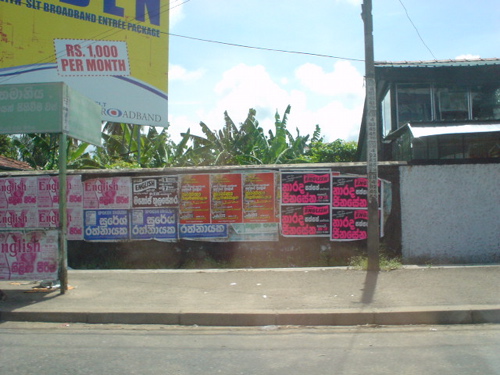
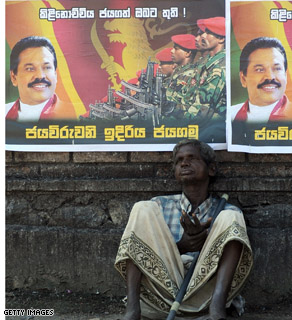
I don’t know many countries which have the caliber of street side posters in Sri Lanka. Ranging from politico profiles to the latest Ranjan Ramanayaka film, these posters fill up the otherwise vacant street side walls. I agree that it might not sound that great to the owner of the wall, but nonetheless I do love to read what they say.


There has also been some heated debate on the standards adopted by movie cut outs. Although I love the colorful and sometimes explicit hoardings, I do have to agree with the fact that these hoardings should be child-friendly.


I relish the though of some form of street/urban art being introduced to Sri Lanka. At the University of Moratuwa the idea seems to be germinating, as some of the walls have been spray painted by the students in to murals of artwork. What was once a monotonous dumb wall now speaks of ideas. In another perspective the walls which once screamed out protesting everything under the sun now has poetically mellowed down.

Dealing with Urbanity and Clipping off Wings


Yesterday unauthorized street vendors were removed from the sidewalks of Pettah. This mode of so called “Unauthorized” Business might have been the sole means of income for many of the poor souls. The TV channel Swarnavahini in their news segment highlighted the woes and pleas of these individuals going to the extent of one person blaming the government that they took this measure only now, because the UPFA (United People's Freedom Alliance: which is the ruling party in Sri Lanka at present) had lost some of the Colombo areas in the recent western provincial election.
The daily mirror has published a photograph depicting the pavements of pettah today. And it looks like somewhere in Dubai. Even though a melting pot of architecture, in Dubai street life wise you never see a person. I spent 7 days in Dubai and except for the South Asian laborers sitting on the carefully maintained green patches waiting for their buses, I didn’t see people walking anywhere. This is obviously due to the blistering heat. And one of the most interesting urban joy stops that I’ve ever encountered were the air conditioned bus stops “Home away from Home” in Dubai.
Cities need to be bustling with life. Cities need bazaars, if the government doesn’t create them people have to make it themselves. Any way bazaars are created by the public for the public. This has been the norm for centuries.
I still recall going to the kirulapona pola (Bazaar) on Saturdays, hanging on to my mothers hand, Even then I was amazed at the enthusiasm, the dynamism that the people brought into this small narrow oddly shaped rows of shops. Then they built a fence, built closed shops and put all the people inside. After that, I haven’t visited that pola again.
The chain supermarket stores have anyway engulfed the individual small shop owners. It is seldom now a days you see the shop at the corner where a king cocnut tree grows in the middle of the shop and commodities ranging from toothpaste to chillie powder are hung on the trunk of the tree, or the small book shop where the mudalali (Owner of the shop) is probably the oldest person you have ever seen, with the musty smell of old paper lingering on to every niche. Every thing has been given up in the name of consumerism and comodification. What ever happen to those ice packets that as kids we loved, but got a good thrashing if parents got any wind of it? Only cargills popsicles are there now a days? By the way what ever happen to the jolly jingling Bombay mutan man? Replaced by the candy floss dude? Sometimes globalization doesn’t seem so attractive.
I would love to have those pavement vendors back again in pettah (unfortunately/fortunately I have no attachments with the governing system in Sri Lanka.) And I also have that nostalgic affiliation to go back to the shop at the corner and buy my self some good old ice palams.

Friday, May 8, 2009

Creating Ghost Towns? - Hambanthota Development


Just looking at the image above gives you an insight on the idiocy of Sri Lankan Town planning. Just take a look at that weird looking building in the middle. Isn’t that the Jumeira Hotel in Dubai!!!...........this was published in the daily news 24th March 2009(http://www.dailynews.lk/2009/03/24/main_Business.asp). Suddenly out of the blues Hambantota is the hippest town in Sri Lanka!

It is agreeable that Sri Lanka does need to develop a city apart from Colombo that can take the tourist/commercial pressures, but finding the suitable city is some what problematic giving the situation that Sri Lanka is at present. To develop a city there should be a pre determined purpose. It can be based on commercial issues, it can be based on industrial issues, and it can be based on tourism. We have seen marvelous examples internationally, take for instance bibao, spain. Frank Ghery’s Gugenheim museam transformed bilbao into a booming tourist hot spot.

Frank Ghery’s Gugenheim Museam, Bilbao


To develop a city you either need a focal point/a catalyst such as the gugenheim museum or you should introduce infrastructure, like what the GOSL trying to do at the moment. So in a certain perspective GOSL is on the right track.


The construction of the Hambantota Port, one of the biggest development projects to be undertaken by the Government. A Chinese consortium comprising China Harbour Engineering Company Ltd and Sino Hydro Corporation Ltd would be in charge of constructing of the Hambantota harbor. Under the first phase of the project, an industrial port with a 1,000m jetty and an oil refinery estimated to cost US$1 billion will be constructed at Hambantota. The proposed port will stimulate development of harbour-related industries such as ship repairs, ship building, bunkering, break bulk, power generation and a free trade zone. I was under the impression that this was developed into a marina where tourist cruise ships would make a intermediate stop point at, and there after tourist attractions would be developed within the city, such as safaris, traditional villages, the bundala national wild life park, the sand dunes of bundala, ( Did you know that Bundala was the village of Andare?)


There is also another theory on why china is backing such a large project. China is increasingly depending on oil import from middle east countries. The sea route for oil imports is of great importance to China and China wants to have a control over this sea route. Sri Lanka, situated in the Indian Ocean is closer to the Marlaca Strait and has a strategic location for the protection of the oil route. Hambantota is located at the southern end of Sri Lanka.


A report from U.S. Joint Forces Command confirms that the commercial-shipping container port at Hambantota being built by Chinese contractors is part of China’s so-called “string of pearls” strategy to gain political influence and be able to project power in the Indian Ocean region. Read more from Lanka Business Online.


However, China has clarified that its backing for the Sri Lankan Hambantota port and bunker terminal project is for commercial purposes only and not as part of a strategic plan to project its power in the Indian Ocean region. Read more from PortWorld.
Are we just pawns in a larger chess board far beyond the comprehension of our 3rd world mindsets?

Proposed Hambanthota Air port


The funniest project by far how ever in the Hambanthota development project is the Air port project.
The Asia tribune reports on 8th March 2008 as follows,
The construction of the second Sri Lankan international airport at the picturesque ancient township of Hambantota is making rapid progress. It is a gigantic undertaking being built at a record pace. The ceremonial laying of the foundation for the airport was made in October 2006, and the spectacular project is now visible to everybody as it rises from bare gound. Weerawilla in Hambantota, the constituency of Sri Lanka's President Rajapakse, will soon be the proud inheritors of a modern airport with all its facilities. The international airport is constructed in an area of 150 hectares with four km runways. It will start operating by 2009 creating a new chapter in the history of the country.

The funny part however is the fact that even though models of the project have been displayed in various forums including Deyata Kirula 2007 ( Very different from the one in the picture above) The design hasn’t been even awarded yet. And some where last year A Rajapakse brother was bold enough to actually make the call to change the location of the proposed site after briefly visiting the site. He literarily made the call through his mobile phone and instructed to change the location. This was even shown on Swarnavahini. (Though I might quote swarnavahini a lot in my posts, please note that I am not paid by the company not work for it.) Who will actually fly via Hamba Air port? If the marina was there it would have been logical to assume that the sudda’s ( a affectionate pet name Sri Lankan’s give White skinned tourists) would travel to Colombo, Sigiri, Pollonnaruwa via Mihin air from Hamba.

Refere here for more blabber on the airport

Apart from these gigantic projects Hambantota is to receive an Administrative Complex and an International Convention Centre with Assistance from Korea. The Government of Korea has agreed to provide a loan equivalent of US$ 20 million (Rs 2,000 mn) for the construction of an Administrative Complex in Hambantota. The total cost of the project is US$ 25 mn (Rs. 2,500 mn) of which US$ 5 mn (Rs. 500 mn) will be provided by the Government of Sri Lanka.

Who will use all this? It is logical to assume that once the infrastructure is in place that people will move in, similar to the situation that we see at the moment along the new constructed (Awesome!) road running from Hamba to Katharagama.


I hope that this new Hambanthota development will not become a ghost town, alien to its inhabitants (similar to what happen in corbusiers chandigargh) and alien to our culture: a mix of charities, looking for their own gains.

Wednesday, May 6, 2009

Creating Ghost Towns? - Hambanthota Development


Just looking at the image above gives you an insight on the idiocy of Sri Lankan Town planning. Just take a look at that weird looking building in the middle. Isn’t that the Jumeira Hotel in Dubai!!!...........this was published in the daily news 24th March 2009(http://www.dailynews.lk/2009/03/24/main_Business.asp). Suddenly out of the blues Hambantota is the hippest town in Sri Lanka!

It is agreeable that Sri Lanka does need to develop a city apart from Colombo that can take the tourist/commercial pressures, but finding the suitable city is some what problematic giving the situation that Sri Lanka is at present. To develop a city there should be a pre determined purpose. It can be based on commercial issues, it can be based on industrial issues, and it can be based on tourism. We have seen marvelous examples internationally, take for instance bibao, spain. Frank Ghery’s Gugenheim museam transformed bilbao into a booming tourist hot spot.

Frank Ghery’s Gugenheim Museam, Bilbao


To develop a city you either need a focal point/a catalyst such as the gugenheim museum or you should introduce infrastructure, like what the GOSL trying to do at the moment. So in a certain perspective GOSL is on the right track.


The construction of the Hambantota Port, one of the biggest development projects to be undertaken by the Government. A Chinese consortium comprising China Harbour Engineering Company Ltd and Sino Hydro Corporation Ltd would be in charge of constructing of the Hambantota harbor. Under the first phase of the project, an industrial port with a 1,000m jetty and an oil refinery estimated to cost US$1 billion will be constructed at Hambantota. The proposed port will stimulate development of harbour-related industries such as ship repairs, ship building, bunkering, break bulk, power generation and a free trade zone. I was under the impression that this was developed into a marina where tourist cruise ships would make a intermediate stop point at, and there after tourist attractions would be developed within the city, such as safaris, traditional villages, the bundala national wild life park, the sand dunes of bundala, ( Did you know that Bundala was the village of Andare?)


There is also another theory on why china is backing such a large project. China is increasingly depending on oil import from middle east countries. The sea route for oil imports is of great importance to China and China wants to have a control over this sea route. Sri Lanka, situated in the Indian Ocean is closer to the Marlaca Strait and has a strategic location for the protection of the oil route. Hambantota is located at the southern end of Sri Lanka.


A report from U.S. Joint Forces Command confirms that the commercial-shipping container port at Hambantota being built by Chinese contractors is part of China’s so-called “string of pearls” strategy to gain political influence and be able to project power in the Indian Ocean region. Read more from Lanka Business Online.


However, China has clarified that its backing for the Sri Lankan Hambantota port and bunker terminal project is for commercial purposes only and not as part of a strategic plan to project its power in the Indian Ocean region. Read more from PortWorld.
Are we just pawns in a larger chess board far beyond the comprehension of our 3rd world mindsets?

Proposed Hambanthota Air port


The funniest project by far how ever in the Hambanthota development project is the Air port project.
The Asia tribune reports on 8th March 2008 as follows,
The construction of the second Sri Lankan international airport at the picturesque ancient township of Hambantota is making rapid progress. It is a gigantic undertaking being built at a record pace. The ceremonial laying of the foundation for the airport was made in October 2006, and the spectacular project is now visible to everybody as it rises from bare gound. Weerawilla in Hambantota, the constituency of Sri Lanka's President Rajapakse, will soon be the proud inheritors of a modern airport with all its facilities. The international airport is constructed in an area of 150 hectares with four km runways. It will start operating by 2009 creating a new chapter in the history of the country.

The funny part however is the fact that even though models of the project have been displayed in various forums including Deyata Kirula 2007 ( Very different from the one in the picture above) The design hasn’t been even awarded yet. And some where last year A Rajapakse brother was bold enough to actually make the call to change the location of the proposed site after briefly visiting the site. He literarily made the call through his mobile phone and instructed to change the location. This was even shown on Swarnavahini. (Though I might quote swarnavahini a lot in my posts, please note that I am not paid by the company not work for it.) Who will actually fly via Hamba Air port? If the marina was there it would have been logical to assume that the sudda’s ( a affectionate pet name Sri Lankan’s give White skinned tourists) would travel to Colombo, Sigiri, Pollonnaruwa via Mihin air from Hamba.

Refere here for more blabber on the airport

Apart from these gigantic projects Hambantota is to receive an Administrative Complex and an International Convention Centre with Assistance from Korea. The Government of Korea has agreed to provide a loan equivalent of US$ 20 million (Rs 2,000 mn) for the construction of an Administrative Complex in Hambantota. The total cost of the project is US$ 25 mn (Rs. 2,500 mn) of which US$ 5 mn (Rs. 500 mn) will be provided by the Government of Sri Lanka.

Who will use all this? It is logical to assume that once the infrastructure is in place that people will move in, similar to the situation that we see at the moment along the new constructed (Awesome!) road running from Hamba to Katharagama.


I hope that this new Hambanthota development will not become a ghost town, alien to its inhabitants (similar to what happen in corbusiers chandigargh) and alien to our culture: a mix of charities, looking for their own gains.

Tuesday, May 5, 2009

Dealing with Urbanity and Clipping off Wings


Yesterday unauthorized street vendors were removed from the sidewalks of Pettah. This mode of so called “Unauthorized” Business might have been the sole means of income for many of the poor souls. The TV channel Swarnavahini in their news segment highlighted the woes and pleas of these individuals going to the extent of one person blaming the government that they took this measure only now, because the UPFA (United People's Freedom Alliance: which is the ruling party in Sri Lanka at present) had lost some of the Colombo areas in the recent western provincial election.
The daily mirror has published a photograph depicting the pavements of pettah today. And it looks like somewhere in Dubai. Even though a melting pot of architecture, in Dubai street life wise you never see a person. I spent 7 days in Dubai and except for the South Asian laborers sitting on the carefully maintained green patches waiting for their buses, I didn’t see people walking anywhere. This is obviously due to the blistering heat. And one of the most interesting urban joy stops that I’ve ever encountered were the air conditioned bus stops “Home away from Home” in Dubai.
Cities need to be bustling with life. Cities need bazaars, if the government doesn’t create them people have to make it themselves. Any way bazaars are created by the public for the public. This has been the norm for centuries.
I still recall going to the kirulapona pola (Bazaar) on Saturdays, hanging on to my mothers hand, Even then I was amazed at the enthusiasm, the dynamism that the people brought into this small narrow oddly shaped rows of shops. Then they built a fence, built closed shops and put all the people inside. After that, I haven’t visited that pola again.
The chain supermarket stores have anyway engulfed the individual small shop owners. It is seldom now a days you see the shop at the corner where a king cocnut tree grows in the middle of the shop and commodities ranging from toothpaste to chillie powder are hung on the trunk of the tree, or the small book shop where the mudalali (Owner of the shop) is probably the oldest person you have ever seen, with the musty smell of old paper lingering on to every niche. Every thing has been given up in the name of consumerism and comodification. What ever happen to those ice packets that as kids we loved, but got a good thrashing if parents got any wind of it? Only cargills popsicles are there now a days? By the way what ever happen to the jolly jingling Bombay mutan man? Replaced by the candy floss dude? Sometimes globalization doesn’t seem so attractive.
I would love to have those pavement vendors back again in pettah (unfortunately/fortunately I have no attachments with the governing system in Sri Lanka.) And I also have that nostalgic affiliation to go back to the shop at the corner and buy my self some good old ice palams.

Monday, May 4, 2009

The Sri Lankan Urbanscape and the Billboard


Reading cernos blog entry on road side advertisements made me want to write one of my own.


If I recall correctly it was at the Architect 2008 annual sessions that this topic got heatedly debated. Many distinguished Architects raised their voices on the use of bill boards/road side hoarding and other distracting advertisement boards proliferating the roadsides not only in and around Colombo but also in outstation areas where we are entertained by the occasional soap drama billboard.


Got this from cerno's blog


The majority were arguing how these hording disrupt the urban scape of Colombo, and I was thinking to my self what urbanscape????????????...I mean to preserve something, that THING should exist. apart from the cluttered haphazard petti kada (Box Shops), and the aluminum clad glass wraped monoliths that rise amidst raging sun and the rising dust, I havent seen much of a urbanscape in colombo. The street vendors of pettah who shout at you when your in a hurry and accidently knocks off one of their things from the make shift shelves on the concrete paving, or the king coconut carts invisible to those inside their air conditioned vehicles are the only signs of life I've vitnessed here. And since I’ve lived/schooled/sleeped/rathiyadued (the past tense of rasthiyadu?) in Colombo for the better part of my life I believe that I am qualified as the next guy to express my views in this regard.

Call me crazy but I find these billboards rather entertaining. I don’t mind glancing upon a billboard advertising some two bit overrated soap on sirasa, driving along galle road or to catch a glimpse of the latest dialog GSM hoarding or even the half way driven car through a billboard! I believe that dynamism is what makes a true urbanscape. And these billboards are some what keeping the streets alive, giving a break to people passing who are tormented by dust, heat and noisy motorists.


I don’t know many countries which have the caliber of street side posters in Sri Lanka. Ranging from politico profiles to the latest Ranjan Ramanayaka film, these posters fill up the otherwise vacant street side walls. I agree that it might not sound that great to the owner of the wall, but nonetheless I do love to read what they say.


There has also been some heated debate on the standards adopted by movie cut outs. Although I love the colorful and sometimes explicit hoardings, I do have to agree with the fact that these hoardings should be child-friendly.


I relish the though of some form of street/urban art being introduced to Sri Lanka. At the University of Moratuwa the idea seems to be germinating, as some of the walls have been spray painted by the students in to murals of artwork. What was once a monotonous dumb wall now speaks of ideas. In another perspective the walls which once screamed out protesting everything under the sun now has poetically mellowed down.